Most of what's called intelligence today lives in language. A model reads a sentence, predicts the next word, and does this well enough to feel, in short bursts, like understanding. But language is a record of a world someone already experienced - it is not the experience itself. A physical machine doesn't get that shortcut. It has to find out what happens when it acts. It has to see a world, touch it, get something wrong, and try again.
We're a company built around a single research question: can an artificial agent learn increasingly general physical behavior through large-scale interaction with dynamic environments, rather than primarily through explicit instructions and demonstrations? Sim Fabric - our infrastructure for generating synthetic worlds - is the first piece of the answer we're building, not the answer itself.
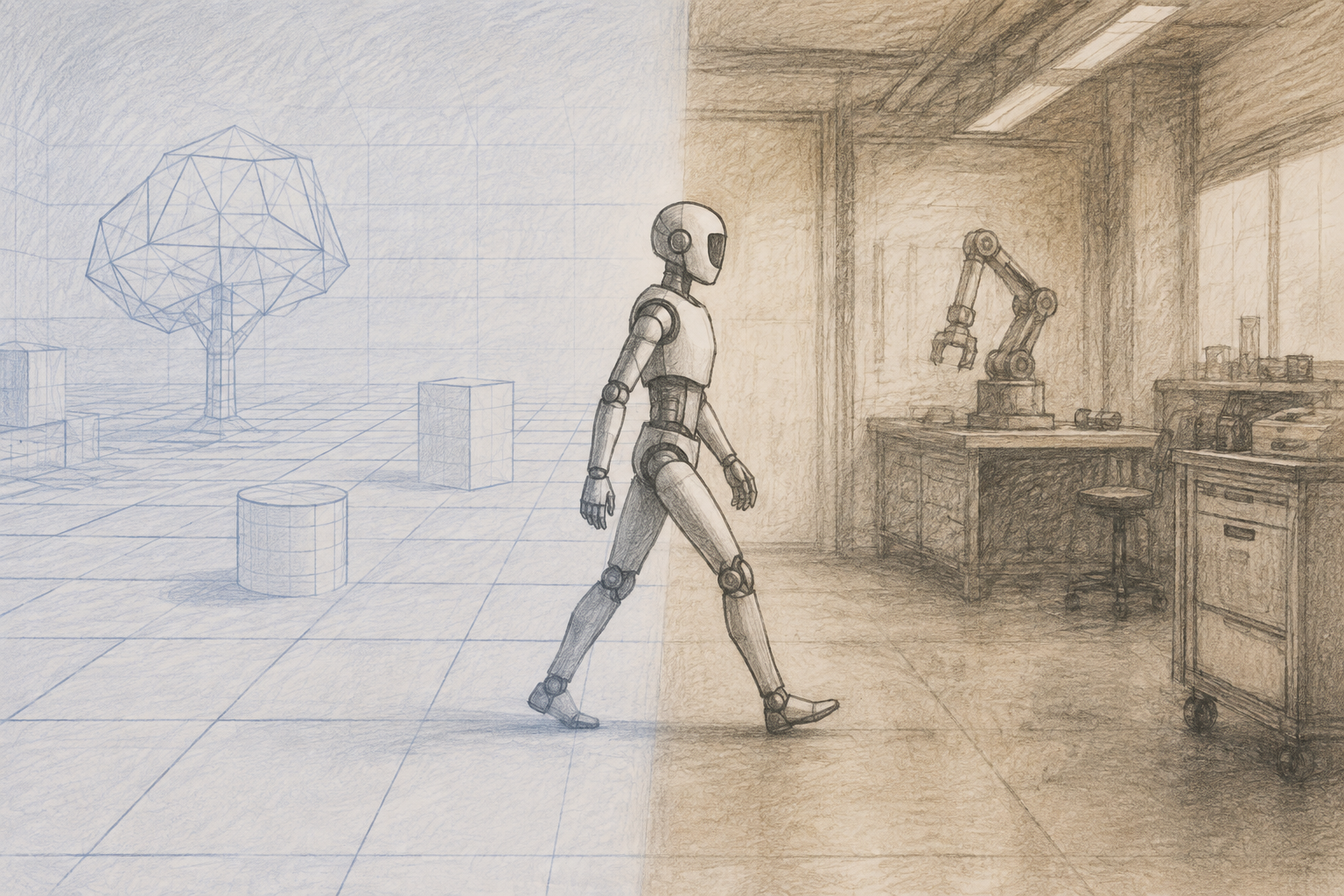
The loop, not the instruction
Ask most robotics systems today to do something, and what you get is a chain: instruction goes in, action comes out. It's the same shape as asking a language model a question. It works, and it's how most of the field's progress has happened. But it leaves out something a physical agent can't actually leave out: consequence.
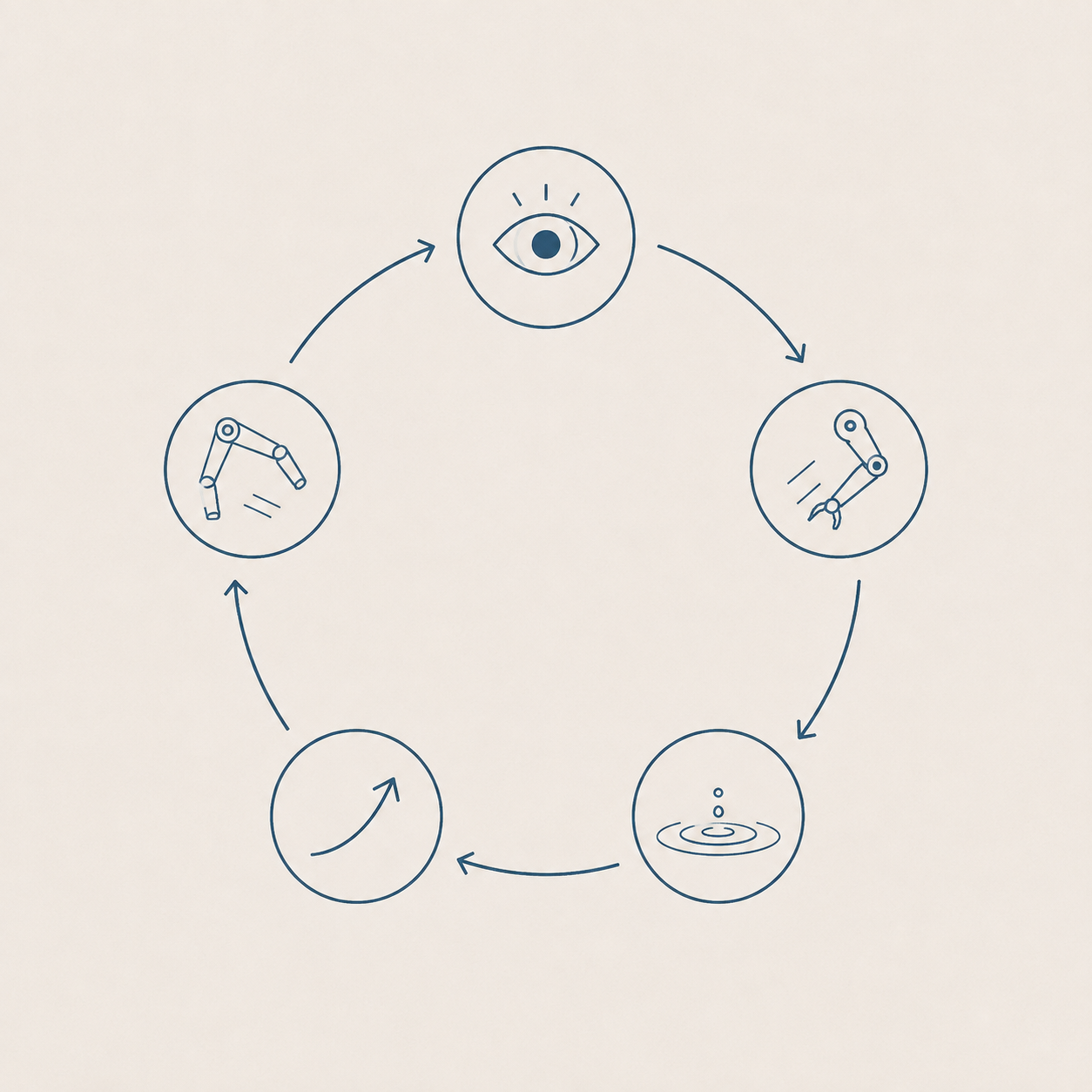
The loop we're interested in looks different:
observe → act → experience consequence → update behavior → act again
The environment isn't a backdrop the agent acts inside of - it's part of the learning problem itself. Friction, timing, contact, balance, occlusion, sensor noise, the unpredictable behavior of other moving things: none of that shows up if you only ever train on instructions and demonstrations. It only shows up when an agent actually has to deal with it, repeatedly, and adjust.
Why a child doesn't need to fall a thousand times
There's a useful comparison here, and we want to be careful with it. A child doesn't need to experience every possible way of losing their balance to learn to walk. Through repeated interaction with the world, they build up something more general than memorized cases - an understanding of the relationship between movement and consequence that lets them respond reasonably to a situation they've never seen in exactly that form before.
We are not claiming to have built anything like a child's brain, and we're not claiming reinforcement learning is literally how human learning works - those would be much stronger claims than our actual thesis needs. What we're asking is narrower and more testable: can an artificial agent, given enough diverse interaction with an environment, develop physical behavior that generalizes the same way - not by encountering every situation, but by encountering enough situations to learn the underlying structure of how the physical world responds to action?
The bottleneck is the real world itself
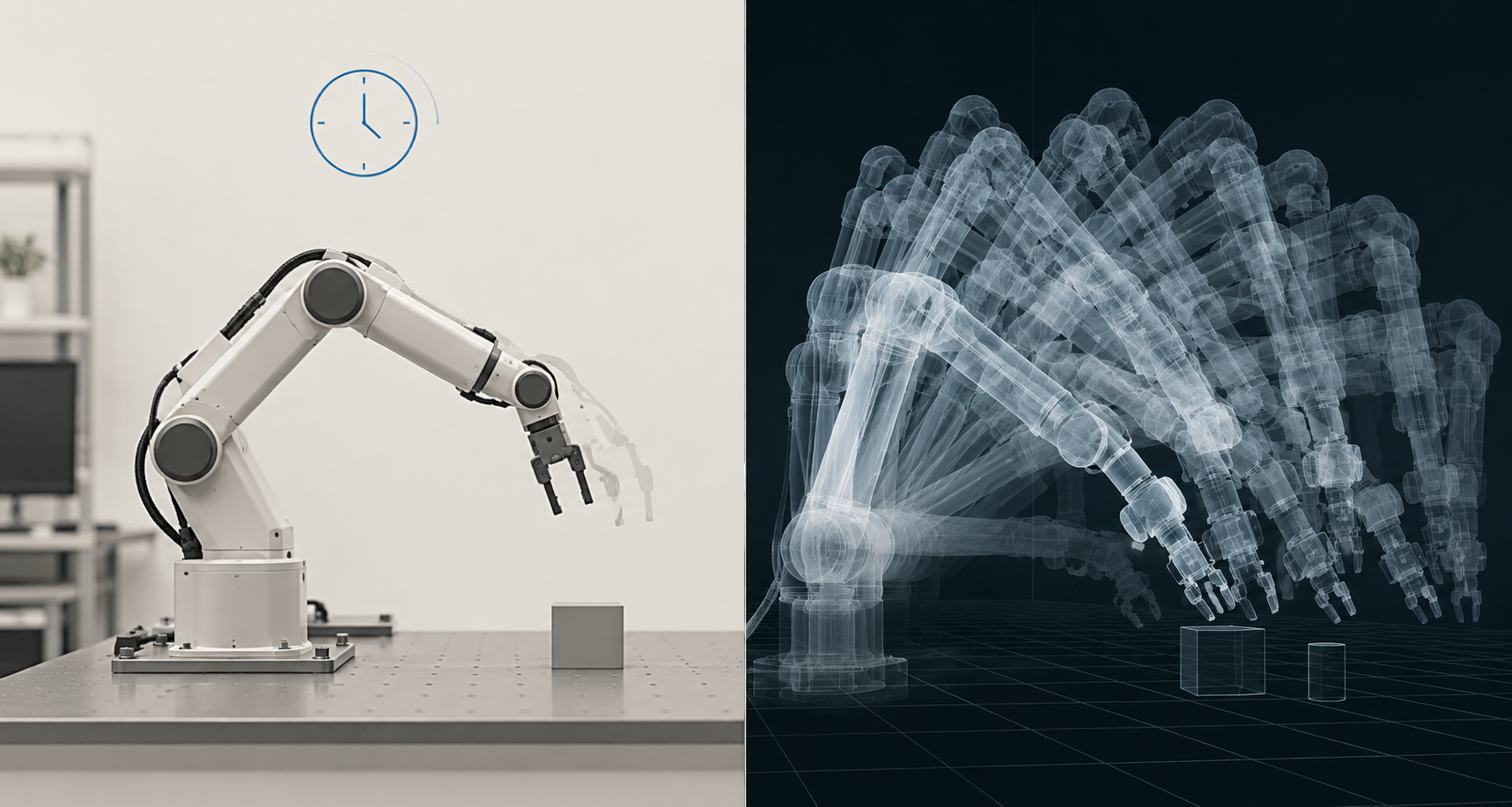
Here's the practical problem with taking that question seriously: the real world is an extraordinary training environment, and it's also brutally expensive. A robot can only run a limited number of experiments at once. Hardware fails. Physical trials take real time, not compute time. The rare, dangerous, or destructive situations - exactly the ones you most want an agent to have handled once, safely, in advance - are the hardest to reproduce on purpose.
Simulation offers a way out of that constraint, in principle. You can create a world, reset it instantly, break it on purpose, change its physics, and let an agent live through situations at a scale no physical lab could match. But that trade introduces its own problem, and it's the one we actually started with: where do all these worlds come from?
The world itself should be programmable
Today, building a single robotics simulation usually means manually finding assets, composing a scene, configuring physics, placing objects, wiring up sensors, and debugging the result until it runs. Every new environment costs real engineering time. If that's true, then the amount of experience an agent can ever have is bounded not by compute, but by how fast a person can build worlds by hand.
That's the actual founding insight behind Sim Fabric: if physical intelligence needs experience, then generating useful experience becomes a foundational infrastructure problem - not a side tool, not a nice-to-have, an actual bottleneck sitting upstream of everything else.
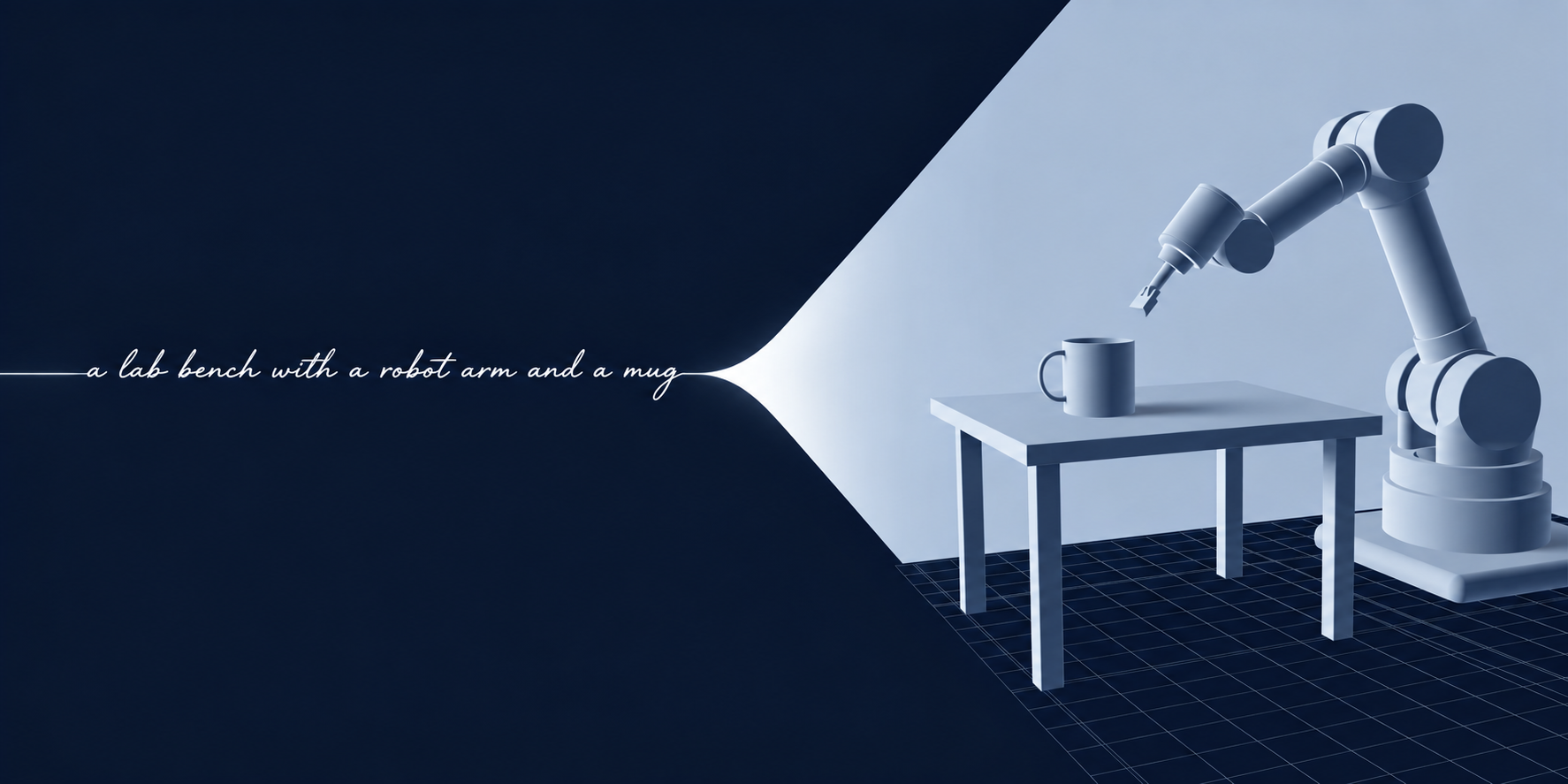
Sim Fabric's first promise is simple to state: describe a world in a sentence; get one a robot simulator can open. Not an image. Not a pretty 3D render. An executable, structured world - physics, objects, sensors, configuration - that can actually participate in a robotics workflow, the same way a real lab bench would.
From one world to distributions of worlds
Generating a single simulated scene is the starting move, not the destination. The real opportunity is in generating distributions of worlds - many controlled variations of the same underlying task, differing in terrain, object placement, lighting, physics parameters, sensor conditions, disturbances, even which robot embodiment is being used. An agent trained against one scene has memorized one scene. An agent trained against a distribution has had to learn something more general to survive all of them.
That shift - from world to worlds - is what turns a simulator into a training ground, and it's the difference between a nice demo and actual infrastructure for learning.
The product-to-research flywheel
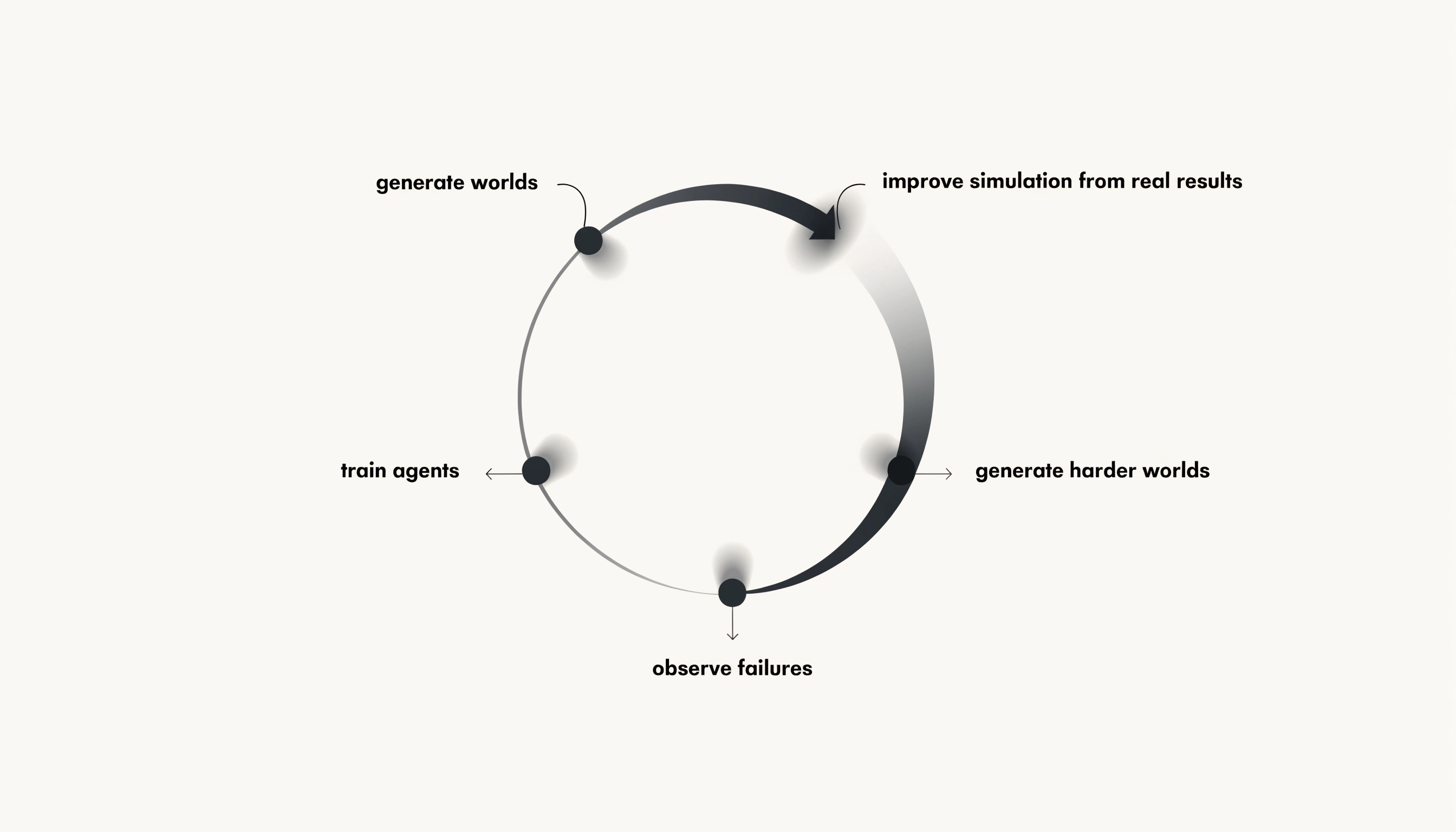
The way we think about this internally is as a loop that feeds itself:
generate environments → train or evaluate agents inside them → observe where they fail → generate harder or more targeted environments in response → train again → evaluate what transfers to real hardware → use real-world results to improve the simulated distribution itself.
Better world-generation makes better intelligence research possible. The requirements coming out of that research - what kinds of failures agents actually need to see, what kinds of variation actually produce robustness - push the world-generation system to get more capable in return. Neither half of that loop is the “real” company on its own; the loop is the company.
Where this goes: short, medium, long term
In the near term, the job is making simulation generation dramatically easier - usable environments from natural-language descriptions, real simulator and robotics file formats, environments that are editable and reproducible rather than one-off outputs, and shrinking the distance between an idea and an executable world. This stage is where Yarn, our first generational model, lives - the fast, first public entry point into Sim Fabric, built to get real researcher feedback quickly rather than to be the final word on world generation.
In the medium term, the goal shifts from single environments to distributions of them - large families of related worlds with controlled variation across physics, geometry, sensing, lighting, and task conditions, built specifically to support reinforcement learning and evaluation, with failure and edge-case generation treated as a first-class capability rather than an afterthought. This is where a more capable system, which we're calling Loom, comes in - its exact technical differentiation from Yarn is something we intend to let the research define, not something we're going to market ahead of the evidence.
In the long term, the questions get harder and more interesting: whole-body learning, continuous perception-action loops, multimodal physical interaction, reflex-like behaviors learned from experience rather than programmed in, robust behavior in genuinely unfamiliar environments, and systems that can acquire new skills rather than only execute the ones they were shown. Fabric, the broadest system in this family, is meant to represent that capability - generating increasingly complex, controllable synthetic worlds and experience distributions - again, with the specifics left to be earned through research rather than announced in advance.
Beyond vision: what richer embodiment could mean
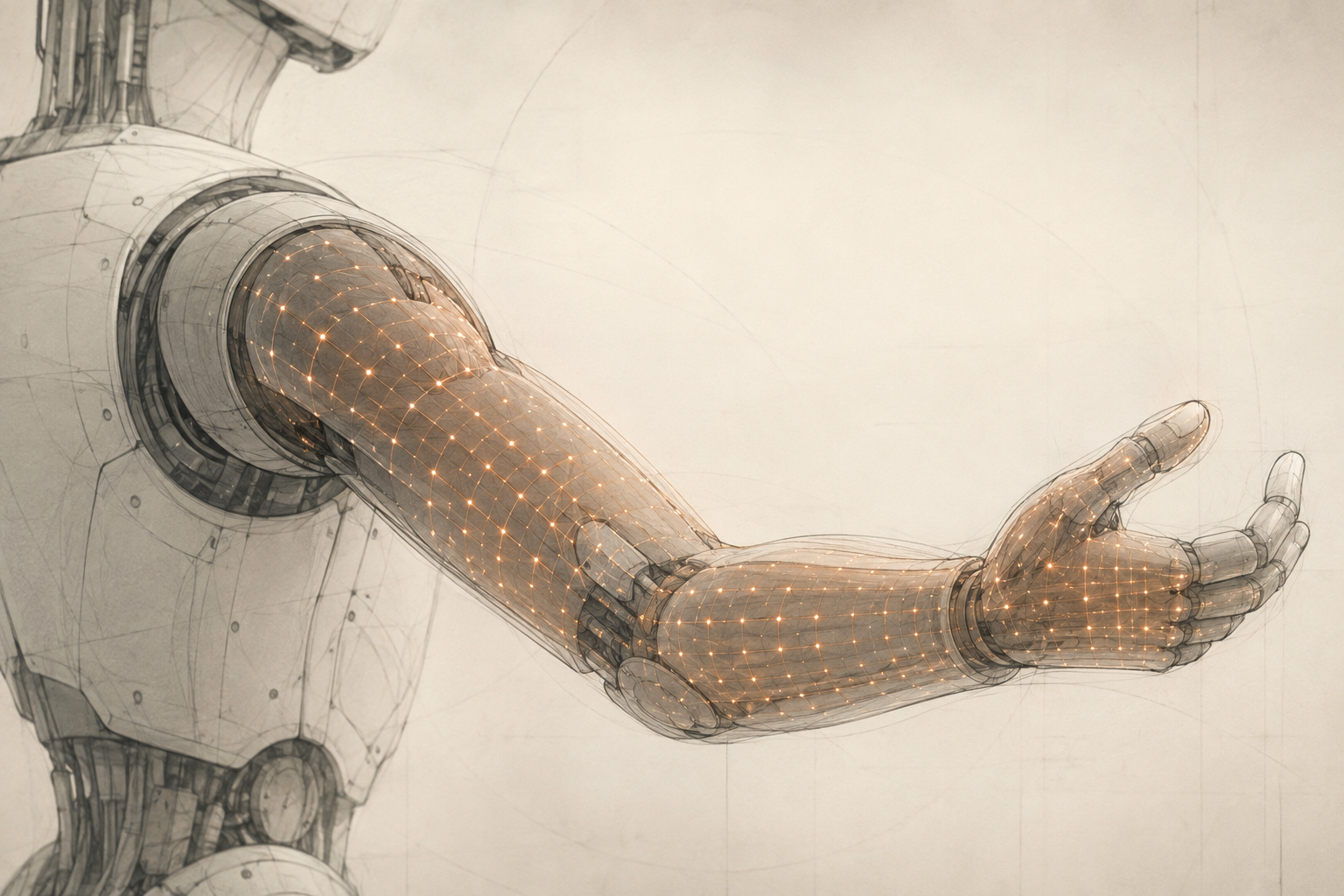
Human interaction with the physical world isn't limited to sight and sound. Our bodies continuously sense contact, pressure, movement, balance, vibration, temperature - an entire channel of information most robots today simply don't have access to across most of their surface.
One future research direction we're genuinely interested in is artificial skin: distributed sensing across a robot's body that could let it perceive contact and physical interaction the way its camera lets it perceive a room. We want to be precise about what this is and isn't. It is not a current product capability, and it is not a promise. It's a research question sitting further down our roadmap: does richer sensory feedback - contact, pressure, slip, vibration, temperature - actually help an agent develop more capable and robust physical behavior, or is vision and proprioception already most of what matters? We don't know the answer yet, and we think that's worth saying plainly rather than implying we do.
The question we want to be known for
Strip away the product names and the roadmap stages, and the whole company reduces to one question we keep coming back to: what happens when an intelligent machine can experience millions of different worlds before it ever enters the real one?
We don't think the answer is already known. What we do believe is defensible: physical agents learn under action-dependent consequences that static data can't provide; real-world experimentation is expensive, slow, and sometimes unsafe; simulation offers a controllable environment for training and evaluation; the diversity of that environment matters for how well anything learned actually generalizes; and generating that diversity by hand doesn't scale, which makes world generation itself a piece of infrastructure worth building well.
Sim Fabric is the first serious attempt at that infrastructure. It is not the goal. Physical intelligence - machines that can act in the world, observe what happens, and get better because of it - is the goal. Everything else is the part of the company that has to exist to make asking that question, seriously, at scale, actually possible.